Capturing crisp celestial images demands a telescope designed specifically for astrophotography success. You can’t just grab any telescope off the shelf and expect great results. A true telescope for astrophotography needs a sturdy mount, precise tracking, and fast optics. Without these, your photos of nebulae or galaxies will look blurry and dissapointing. You deserve better than that.
So, how do you find the right one? It’s not about the biggest aperture or the flashiest brand. Your setup needs to balance light-gathering power with a steady platform. We’ve tested several models to see which ones actually deliver stunning deep-sky images. Trust me, the right gear makes all the differnce between a frustrating night and a magical one.
Product Comparison Table: 9 Best Telescope For Astrophotography
| Image | Why We Like This Product | Editor’s Rating | |
 |
DWARFLAB Dwarf 3 Smart Telescope – Portable Astrophotography Camera,…
|
9.8 |
Read Review |
 |
Smart Telescope, Professional Refractor Auto-focus Portable Digital Electronic Telescopes…
|
9.6 |
Read Review |
 |
Celestron – NexStar 130SLT Computerized Telescope – Compact and…
|
9.3 |
Read Review |
 |
MEEZAA Telescope, 150EQ Newtonian Reflector Telescope for Adults Astronomy…
|
9.1 |
Read Review |
 |
Celestron StarSense Explorer LT 114AZ App-Enabled Telescope – 114mm…
|
8.8 |
Read Review |
 |
ZWO Seestar S30 Pro Smart Telescope, 4K Dual Camera…
|
8.6 |
Read Review |
 |
DWARFLAB Dwarf Mini Smart Telescope – 1.85lb Ultra-Portable Astronomy…
|
8.3 |
Read Review |
 |
Smart Telescope, Digital Electronic Telescopes with 4K Astrophotography Camera,…
|
8.1 |
Read Review |
 |
Celestron – AstroMaster 130EQ Newtonian Telescope – Manual Reflector…
|
7.8 |
Read Review |
Quick Review For Top 9 Telescope For Astrophotography
DWARFLAB Dwarf 3 Smart Telescope – Portable Astrophotography Camera, Capture Astronomy/Wildlife/Panorama, AZ/EQ Mode, Built-in Processing, 4K Auto-Tracking, Ultra-Light 3lb, Ideal for All Ages

The DWARFLAB Dwarf 3 Smart Telescope is a portable astrophotography camera that proves you don’t need heavy, complicated gear to capture the night sky. Weighing only 3 pounds, it’s the world’s most portable smart telescope. You can slip it into a standard backpack for spontaneous stargazing trips or wildlife walks. It’s built for all adventures, no matter how spontaneous.
This telescope uses a dual imaging system for both day and night.
One telephoto lens is for wildlife, landscapes, and deep space objects. The other is a wide-angle lens for capturing the Milky Way or star trails. During the day, the telephoto lens focuses on your subject while the wide-angle helps you locate it. It’s a simple dual-camera setup that works around the clock.
The auto-tracking feature is 4K and professional-grade. It automatically follows stars, planets, or moving wildlife.
You don’t need to manualy adjust anything—just let the telescope do the work. The result is crisp, clear shots every time. Whether you’re tracking a bird or the moon, the system keeps your target in frame.
Image processing happens in the cloud through the DWARFLAB App. With one tap, you can enhance your photos using cloud computing power. No PC or complex software required. From capture to final image, it takes just minutes.
Smart Telescope, Professional Refractor Auto-focus Portable Digital Electronic Telescopes with 4K Astrophotography Camera, Internal And External Dual Screens Spotter for Adults and Beginners Astronomy

The Smart Telescope Professional Refractor Auto-focus Portable Digital Electronic Telescope with 4K Astrophotography Camera is a straightforward tool for anyone curious about the night sky. It comes with an 80mm aperture and a 300mm focal length. That means you get clear, bright views without a lot of fuss. The starlight-grade sensor lets you push magnification up to 350X, so distant objects feel close. You can also capture 4K images, even when the light is low or your looking at the moon.
It handles those conditions well.
You get two screens for real-time viewing. One is an eyepiece with diopter adjustment that goes from -4 to +4, so you can dial in the focus if you wear glasses. The other is a foldable external screen. It has a built-in sunshade, which helps when you are out during the day. You can watch the image directly on the screen without squinting. It makes the whole experience more natural.
Switching between photo and video is a one-touch thing.
No extra gadgets needed. You just press a button and start capturing. The telescope supports external storage up to 512GB, so you can save a lot of shots and clips. Share them later with friends or keep them for your own records. The battery is a 4500mAh unit. It runs for up to 6 hours on a full charge. There is also an auto power-off feature you can set to 1, 3, 5, or 10 minutes. That helps you save battery when you forget to turn it off.
This telescope is not just for stars.
Celestron – NexStar 130SLT Computerized Telescope – Compact and Portable – Newtonian Reflector Optical Design – SkyAlign Technology – Computerized Hand Control – 130mm Aperture Grey

The Celestron NexStar 130SLT Computerized Telescope is a solid option if you want to see what is up in the night sky without the frustration of manual setups. It is a Newtonian Reflector telescope with a 130mm aperture, meaning it collects a good amount of light for its size. You get a clear view of Saturn’s rings, Jupiter’s cloud bands, and the Moon in sharp detail.
The optical design is simple and effective, making it a reliable choice for both adults and older kids.
This telescope is built to be compact and portable. You can take it on weekend camping trips or to darker sky locations without much hassle. It assembles quickly, so you spend less time fiddling and more time looking. The computerized hand control is where this scope really shines. It has a database of over 4,000 objects, including stars, galaxies, and nebulae.
With SkyAlign technology, you just align it on three bright objects, and the telescope locates your target automatically. It tracks the object as it moves across the sky, which is really handy for long looks or sharing views with others.
The 130SLT is the largest model in the SLT family, so you get a bit more light gathering than its smaller siblings. It is compatible with 2 inch eyepieces, giving you flexibility to upgrade later.
MEEZAA Telescope, 150EQ Newtonian Reflector Telescope for Adults Astronomy Beginners, Professional Astronomical Telescopes with Equatorial Mount, Phone Adapter, Tripod, Moon Filter and Large Carry Bag
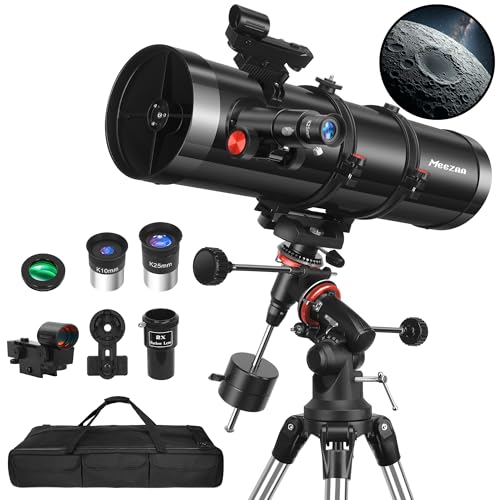
The MEEZAA Telescope, 150EQ Newtonian Reflector Telescope for Adults Astronomy Beginners is a solid piece of kit for anyone wanting to get serious about stargazing. It is built around a 150mm large aperture and a 650mm focal length. That means it gathers plenty of light, so you get bright and clear views of deep space objects, planets, and the Moon. You will see details you never noticed before. Magnification is flexible and easy to adjust.
You get two eyepieces, a 25mm and a 10mm, plus a 2X Barlow lens. That gives you a range from 26X all the way up to 130X. The red dot finderscope helps you lock onto targets fast, so you are not fumbling around in the dark. There is also a moon filter included. It cuts down glare, making lunar viewing comfortable on your eyes. The optics are clear and work well for beginners. The mount is a German equatorial type with an upgrade. It has precision dials and slow-motion control knobs.
That means you can track the Moon, planets, and stars smoothly as they move across the sky. It is a good design for learning how astronomy works. The tripod is heavy-duty stainless steel with adjustable height, so it stays stable even on uneven ground. There is a built-in accessory tray to keep your eyepieces organized. Everything, including the telescope tube, fits into the large carry bag. That makes storage and travel simple. You get a full set of accessories.
Celestron StarSense Explorer LT 114AZ App-Enabled Telescope – 114mm Newtonian Reflector with Smartphone Dock & StarSense App – iPhone & Android Compatible – Easy-to-Use for Beginners
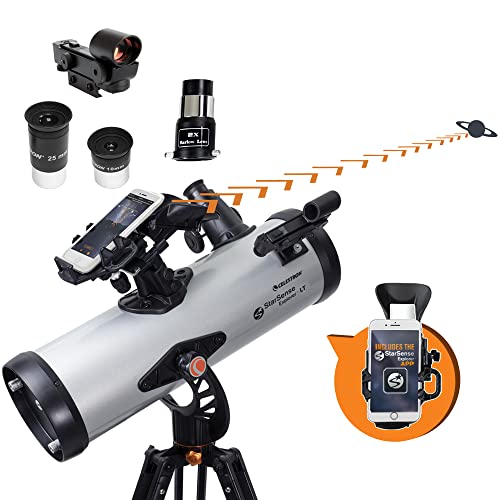
The Celestron StarSense Explorer LT 114AZ App-Enabled Telescope is built for people who want to see the night sky without needing a degree in astronomy. You dont need any prior experience to get started. Just dock your smartphone into the included mount, launch the StarSense Explorer app, and follow the on-screen arrows to locate stars, planets, nebulae, and more.
It’s that simple.
Unlike regular astronomy apps that just show you a map, this telescope uses patented StarSense technology. The app analyzes the star patterns overhead to figure out exactly where your telescope is pointed. It turns your phone into a celestial navigation system. You don’t have to manually align anything or guess which star is which.
The tech does the heavy lifting for you.
Once you’re set up, the app generates a list of the best objects to view based on your exact time and location. It curates the top targets for tonight—things like bright planets, nebulae, galaxies, and star clusters. You can see these from your backyard in the city, and even more if you get to darker skies. The app updates instantly, so you always know what’s worth looking at.
Setting up the telescope is straightforward.
ZWO Seestar S30 Pro Smart Telescope, 4K Dual Camera Astrophotography Telescope with Auto Tracking & GoTo, App-Controlled, One-Tap Capture & Processing for Milky Way, Deep Sky and Wide-Field Imaging

The ZWO Seestar S30 Pro Smart Telescope is designed to make astrophotography simple for anyone. You don’t need to be an expert to capture stunning images of the night sky. Just power it on, connect the app, and let the telescope do the heavy lifting. The automatic GOTO targeting and tracking finds and follows celestial objects for you, so you can focus on enjoying the view rather than fiddling with complicated setup.
This smart telescope comes with a 4K dual-camera system.
It has a powerful IMX585 telephoto sensor for sharp deep-sky objects and a wide-angle IMX586 camera for expansive night landscapes. You can easily switch between detailed space views and wide Milky Way scenes. The one-tap capture feature lets you photograph the Milky Way, star trails, planets, and galaxies using four intelligent imaging modes. Built-in mosaic stitching automatically combines multiple frames to create breathtaking 8K ultra-wide astrophotography images.
It’s a lot of power in a compact package.
The optics are professional grade. A precision 4-element apochromatic lens reduces chromatic aberration, giving you sharper stars and deeper contrast. Built-in filters help cut through light pollution and unwanted infrared light, making it easier to reveal nebulae and deep-sky objects even if you live in suburban areas. The intelligent astrophotography assistant includes automatic noise reduction and AI scene recognition.
DWARFLAB Dwarf Mini Smart Telescope – 1.85lb Ultra-Portable Astronomy Telescope for Astrophotography with Built-in Filters, Auto GOTO, AZ/EQ Mode and Cloud Processing, Ideal for All Ages

The DWARFLAB Dwarf Mini Smart Telescope is a ultra-portable astronomy tool that weighs just 1.85 pounds. That is light enough to toss into a backpack or even a large coat pocket. It is an all-in-one digital telescope designed for quick trips to dark-sky spots, camping, or hiking. You can take it anywhere without fussing with heavy gear.
Getting started is fast. From unboxing to your first image, it takes about three minutes. The DWARFLAB App gives you an interactive star map.
You just pick a target on the screen, and the telescope points there automatically. There is no steep learning curve. It works for beginners, kids, and adults alike. The auto GOTO feature provides full 360-degree rotation, so you can track objects smoothly across the sky. A Sony IMX662 sensor (1/2.8-inch, 2.9μm pixels) captures low-noise astro details. Faint nebulas and star clusters show up with clear, bright detail.
For deeper space work, the Equatorial (EQ) Mode is a real step up.
It supports single-frame exposures of up to 90 seconds. That lets you capture more light from distant objects. Built-in light pollution filters help cut through city glow. You do not need a perfectly dark site to get good results. The telescope also has a smart cloud processing feature. It takes your raw data and enhances it automatically. The results look professional-grade without you needing to learn complex editing software.
The whole package is simple and direct.
Smart Telescope, Digital Electronic Telescopes with 4K Astrophotography Camera, Internal and Externat Dual Screens Spotter for Adults & Kids & Beginners Astronomy with 64G Card

The Smart Telescope Digital Electronic Telescope with 4K Astrophotography Camera is built for sharing the night sky with others. It comes with two screens. The foldable external 3-inch screen lets you and your family watch the stars together in real time. There is also a built-in sunshade that keeps the view clear even during bright daylight. It makes observing easy and comfortable for everyone, from kids to adults.
This telescope uses a 300mm focal length and an 80mm aperture.
The fully coated optics glass lens with high transmission coatings helps create sharp, bright images while protecting your eyes. It is a full positive telescope, meaning what you see is correctly oriented. Perfect for astronomers who want to study the moon and stars without straining their eyes.
You get some serious magnification power here. The starlight-grade sensor supports up to 350X magnification for long-distance viewing.
It also captures stunning 4K high-resolution images, even in low light or when looking at the moon. The included eyepiece has adjustable vision compensation with a diopter range of +/-6. This means you can fine-tune the focus to match your eyesight, no matter if you wear glasses or not.
Taking photos and videos is simple. With one touch, you can switch between photo and video modes. No extra devices needed.
Celestron – AstroMaster 130EQ Newtonian Telescope – Manual Reflector for Beginners – Aluminized Mirror – Adjustable-Height Tripod – Includes Accessories Plus Astronomy Software Package
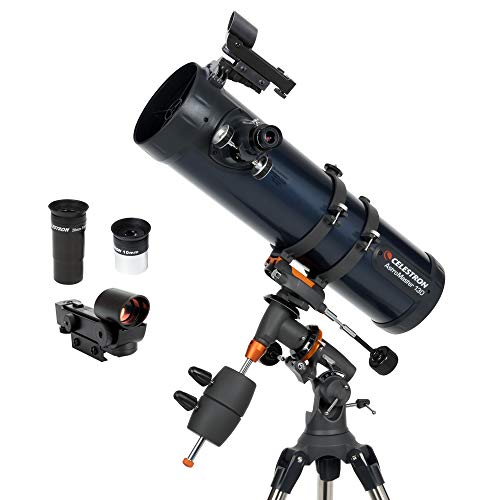
The Celestron AstroMaster 130EQ Newtonian Telescope is a manual reflector built for beginners who are serious about seeing the night sky. It gives you sharp views without needing a computer or complicated electronics. The main mirror is 130mm wide, which is about five inches. That might not sound huge, but it catches enough light to clearly show you things like the rings of Saturn, the bands on Jupiter, and the Orion Nebula.
The mirror has aluminum and SiO₂ coatings, so the images stay bright and crisp.
This telescope uses a Newtonian reflector design, which means it uses mirrors instead of lenses to gather light. That keeps the cost down while still giving you great performance. The equatorial mount is a big part of why this scope works well. It lets you track objects in the sky by turning just one knob at a time. There are two slow-motion control knobs for right ascension and declination.
They let you move the telescope smoothly, making it easy to keep a planet or a star cluster centered in the eyepiece. The tripod is adjustable, so you can set it up at a height that works for you. You can use it sitting down or standing up. It is also sturdy, which helps reduce shaking in the wind.
Setting up the AstroMaster 130EQ is pretty straight forward. There are only a few main parts to put together, and you don’t need any tools.
Telescope For Astrophotography Buying Guide
Capture stunning night sky images with a telescope suited for astrophotography beginners. You don’t need to be a pro to start snapping photos of teh moon, planets, or even distant galaxies. The right gear matters though. Without it, you will likely get blurry stars or frustrated. Let’s skip the confusion. Here’s what you should look for when choosing your first setup.
Mount Stability
Your mount is the most important piece. A shaky mount makes every picture a blurry mess. Think of it like trying to take a photo from a moving car – it just won’t work. Look for a mount that can track the night sky as the Earth rotates. This is called an equatorial mount. It keeps your target centered for long exposures. If your budget is tight, a sturdy alt-azimuth mount can work for short shots. But for real deep-sky images, go equatorial.
Aperture Size
Bigger aperture means more light. More light means clearer, brighter images. For astrophotography, a 70mm to 100mm aperture is a solid start for beginners. Smaller apertures work for planets but struggle with faint nebula. A classic 80mm refractor is a safe bet. It’s portable, easy to use, and captures decent detail. Dont overspend on a huge telescope – the mount matters more.
Focal Ratio
Fast or slow? Focal ratio tells you that. A fast telescope (f/4 to f/6) gathers light quickly. That means shorter exposure times, which is great for beginners. A slow telescope (f/8 or higher) needs longer exposures but gives sharper detail on planets. For all-around use, aim for f/6 or f/7. It gives you flexibility without pushing your gear to the limit.
Camera Compatibility
Not all telescopes work with every camera. Check if the telescope has a T-ring adapter or a dedicated camera port. Some come with a DSLR attachment built in. Others need extra parts. If you already have a camera, pick a telescope that fits it. If not, consider a telescope that includes a simple planetary camera – it saves you hassle later.
Frequently Asked Questions About Telescope For Astrophotography
What’s the best telescope for a beginner in astrophotography?
Start with a small refractor telescope. They are easy to use and need less maintenance. A 80mm or 90mm apochromatic refractor is a great choice. It gives sharp images without color fringing. You’ll have more fun learning the basics.
Do I need a special mount for astrophotography?
Yes, very much so. The mount is more important than the telescope. You need a sturdy equatorial mount that can track the stars. A good mount lets you take long exposures without star trails. Don’t skimp on it. A wobbly mount will ruin your photos.
Can I use my regular camera with a telescope?
You sure can. Most DSLR or mirrorless cameras work fine. You’ll need a T-ring and adapter to connect them. This setup is called prime focus astrophotography. It gives you full control over settings and image quality.
What’s the difference between a reflector and refractor for astrophotography?
Reflectors use mirrors and are cheaper per inch of aperture. They can suffer from coma, which makes stars look like comets at the edges. Refractors use lenses and deliver sharper stars across the frame. For deep-sky photos, a small refractor is often easier to manage.
How much should I spend on a starter setup?
Plan for around $1,000 to $1,500. That covers a good mount, a small telescope, and basic accessories. You can spend less but expect more frustration. Buy used gear from trusted sources to save money. Remember, the mount takes half your budget.
Do I need autoguiding for astrophotography?
Not right away. You can start with short exposures of 30 to 60 seconds. Autoguiding corrects tiny tracking errors during longer exposures. It helps you get sharp, detailed images. But it’s an upgrade you can add later.
What software do I need to process images?
Free software like DeepSkyStacker and GIMP work well for beginners. They stack multiple photos to reduce noise. You can also try Siril for more advanced editing. No need to buy expensive programs right off the bat.
Can astrophotography be done from a city?
It’s harder but possible. Light pollution washes out faint objects. Use a light pollution filter to block sodium and mercury lights. Focus on bright targets like the Moon, planets, and star clusters. You’ll get decent results while learning.
Before You Decide
Think about what you want to photograph. Deep space objects like galaxies need a telescope with a fast focal ratio. Planets need more magnification. Your budget matters too, but you don’t have to spend a fortune to get started. A decent mount is more important than the tube itself. Without a steady platform, even the best optics will give you blurry stars. Check the weight capacity. Leave room for a camera, guide scope, and cables. Read reviews from other astrophotographers. They often share tips that save you time and money. Start simple. You can always upgrade later. The goal is to have fun while learning.
When you pick the right gear, the night sky opens up in a whole new way. You will capture details you never noticed before. The process takes patience, but every clear night is a chance to improve. Your first good image will make all the effort worth it. Choose a telescope for astrophotography that fits your skill level and goals. That way, you build confidence with every session. The stars are waiting. Your next image could be the one that surprises you the most.